Concrete Patios: Poured, Finished and Built to Drain
A patio is the one piece of concrete people spend real time standing on, so the finish matters as much as the structure. It also has to shed water away from the house, which is where a lot of otherwise decent patios go wrong.
Getting the fundamentals right
Pitch. A patio should fall away from the house at roughly a quarter inch per foot. Flat looks appealing on paper and puts water against your foundation.
Base. Four to six inches of compacted stone under the slab, more where drainage is poor. Concrete poured on undisturbed topsoil settles as the organic material below it breaks down.
Thickness and joints. Four inches with control joints laid out in roughly square panels. Long thin panels crack across the middle regardless of the concrete quality.
Finish. A broom finish gives grip when wet, which matters near a pool or on any patio that sees rain. Smoother finishes look better and get slippery.
Finish options
Broom finish is the standard, hard wearing and inexpensive.
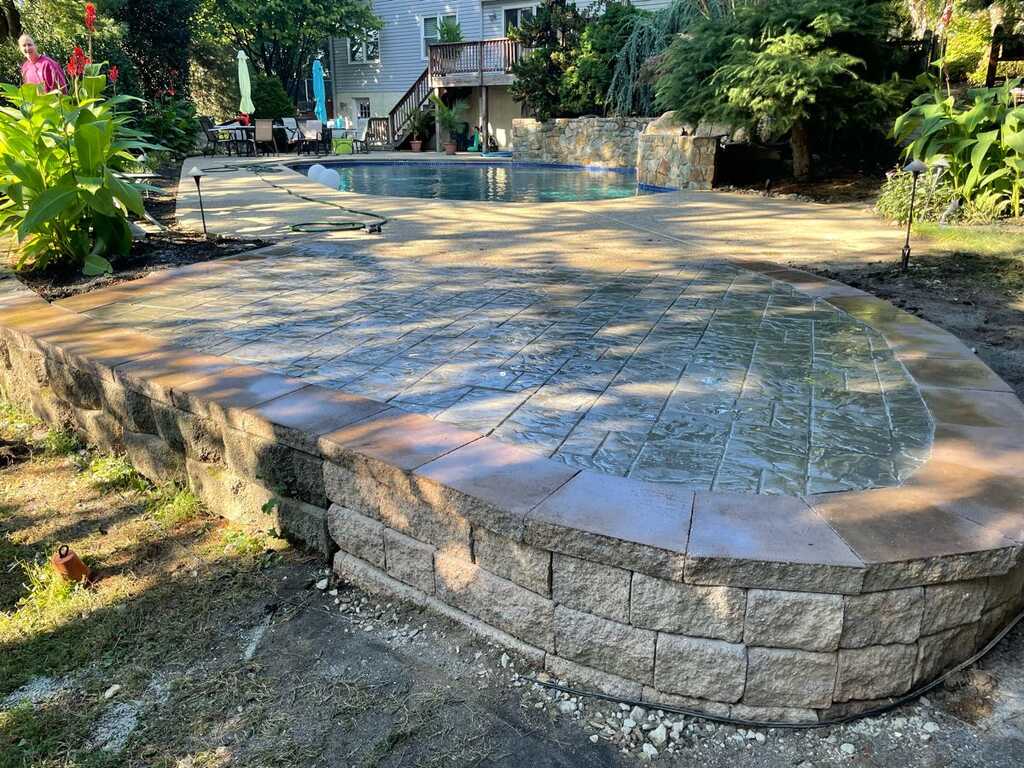
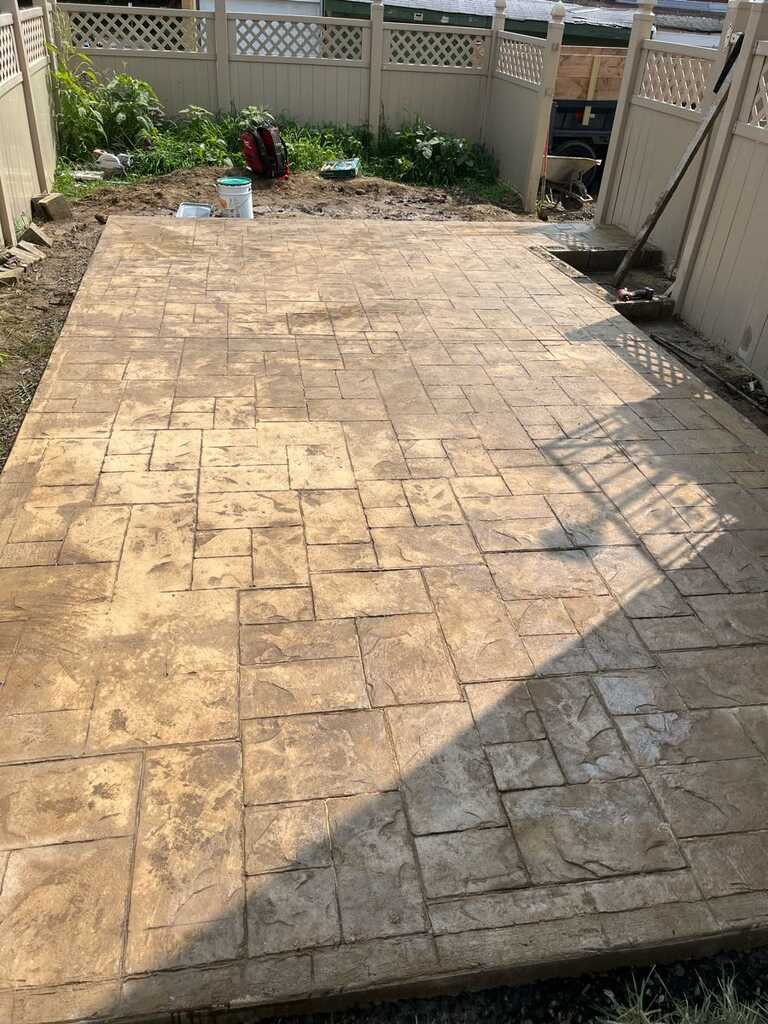
Stamped concrete presses a pattern into the surface before it sets, giving the appearance of stone, slate or brick at lower cost than the real material.
Integral color runs pigment through the whole mix rather than sitting on the surface, so it does not wear off the way a surface stain can.
Exposed aggregate washes back the top layer of cement to reveal the stone, giving a durable textured surface with natural grip.
Other concrete we handle
Concrete Driveways
Poured concrete driveways with proper thickness, reinforcement and control joints.
Concrete Driveways detailsStamped Concrete
Stamped patterns, integral color and exposed aggregate finishes, sealed to hold up outdoors.
Stamped Concrete detailsConcrete Repair
Honest assessment of what can be repaired and what has to be replaced.
Concrete Repair detailsSteps & Stoops
Front steps and stoops rebuilt level, safe and matched to the house.
Steps & Stoops detailsConcrete Leveling
Lifting settled slabs back to grade when the concrete itself is still sound.
Concrete Leveling detailsSidewalks & Walkways
Public sidewalk replacement and private walkways, including township permit work.
Sidewalks & Walkways detailsConcrete Patios by town
Concrete Patios we have finished
Concrete Patios questions
How thick should a concrete patio be?
Four inches over a compacted stone base is the standard for a residential patio carrying furniture and foot traffic.
Go thicker where a hot tub, outdoor kitchen or anything heavy will sit. A filled hot tub is a large concentrated load and a four inch slab is not designed for it.
Do I need gravel under a concrete patio?
Yes, in almost every case. A compacted stone base does three things: it spreads the load, it lets water drain away instead of collecting under the slab, and it gives a stable surface that will not settle.
Pouring straight onto soil, and especially onto grass or topsoil, means the organic material below decomposes and leaves voids. The slab then cracks into those voids.
Is a concrete patio cheaper than pavers?
Poured concrete usually costs less to install than a comparable paver patio, because pavers carry both higher material costs and more labor.
Pavers have real advantages though. Individual units can be lifted and reset if something settles, and they do not crack the way a slab does. Concrete gives a continuous surface with no joints for weeds and generally costs less.
How long does a concrete patio take to build?
Most residential patios are excavated, based, formed and poured within a few days, weather permitting.
The wait afterwards is longer than the work. Keep off it for twenty four to forty eight hours, hold off on furniture for about a week, and expect full strength at around twenty eight days.
Get a free estimate
Send a few photos of the driveway, patio or drainage problem and we will come back with a real number, not a range.
- Most estimates come back within one business day.
- Photos usually get you a real number without a site visit.
- If you need less work than you asked about, we will say so.
Prefer to talk? (610) 646-1187